LNG Import and Regasification Solutions
Onshore and Offshore Regas Systems
We provide access to flexible LNG import, storage and regasification solutions designed to meet different project requirements, site conditions and gas demand profiles. We help project developers and owners procure the right equipment, systems and turnkey solutions for their specific needs and LNG projects worldwide.
The principal configurations that can be considered are:
FSRU, FSU + Onshore Regasification, FSU + Offshore Regasification and Onshore LNG Terminal.
LNG Supply & Ship-to-Ship (STS) Transfer
For both FSRU and FSU solutions, LNG is supplied by conventional LNG carriers. Depending on the selected marine configuration and site conditions, LNG is transferred from the LNG carrier to the FSRU or FSU through a Ship-to-Ship (STS) LNG transfer operation using appropriate cryogenic transfer equipment.
The FSRU or FSU then provides the floating LNG storage and receiving capacity, creating a buffer between international LNG deliveries and the regasification system.
Typical LNG supply chain:
Global LNG Supply → LNG Carrier → STS LNG Transfer → FSRU / FSU → Regasification → Gas Transmission Grid / Power Plant

FSRU
Floating Storage & Regasification Unit
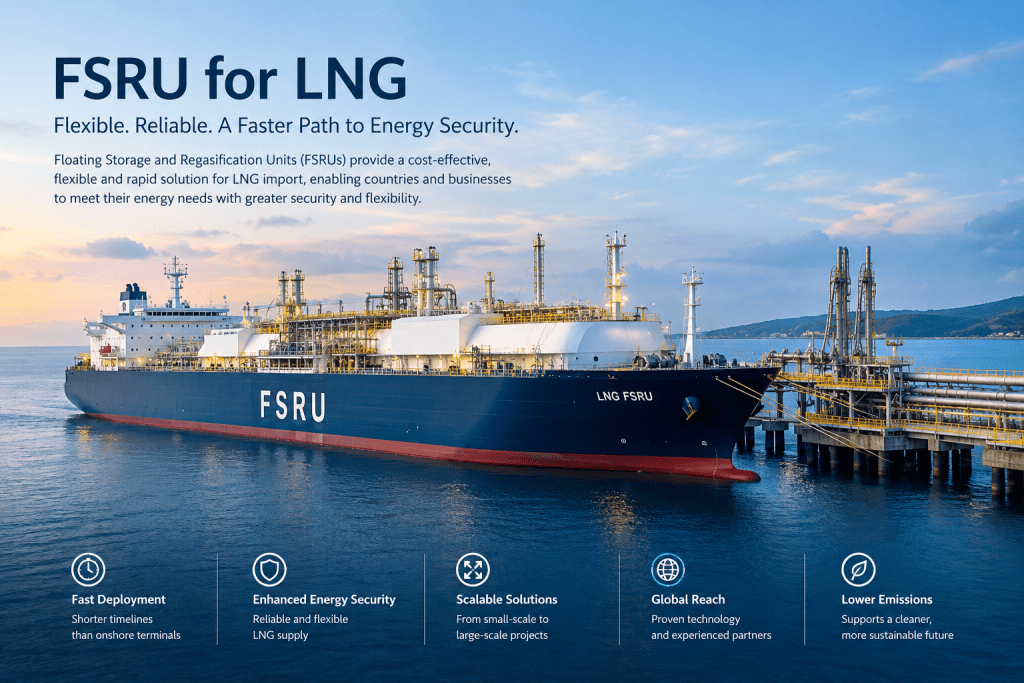
Integrated Floating LNG Storage & Regasification
An FSRU combines LNG storage and regasification in a single floating facility.
How It Works
LNG is delivered by LNG carriers and transferred to the FSRU through STS operations. The LNG is stored onboard and regasified using the FSRU’s integrated regasification system. The resulting natural gas is exported through a high-pressure gas pipeline to shore and then to the transmission grid or power plant.
Key Components
- LNG storage tanks
- Onboard regasification system
- LNG pumps and associated process equipment
- Gas metering, conditioning and export facilities
- Marine mooring and LNG transfer system
- High-pressure gas export pipeline
Key Advantages
- Integrated floating solution
- Minimal onshore LNG infrastructure
- Suitable for large-scale and continuous gas supply
- Proven technology with established operating experience
- Can be deployed where suitable marine infrastructure is available
Best Suited For
Large-scale LNG import projects where floating storage and regasification in one facility is preferred.
FSU + Onshore Regasification
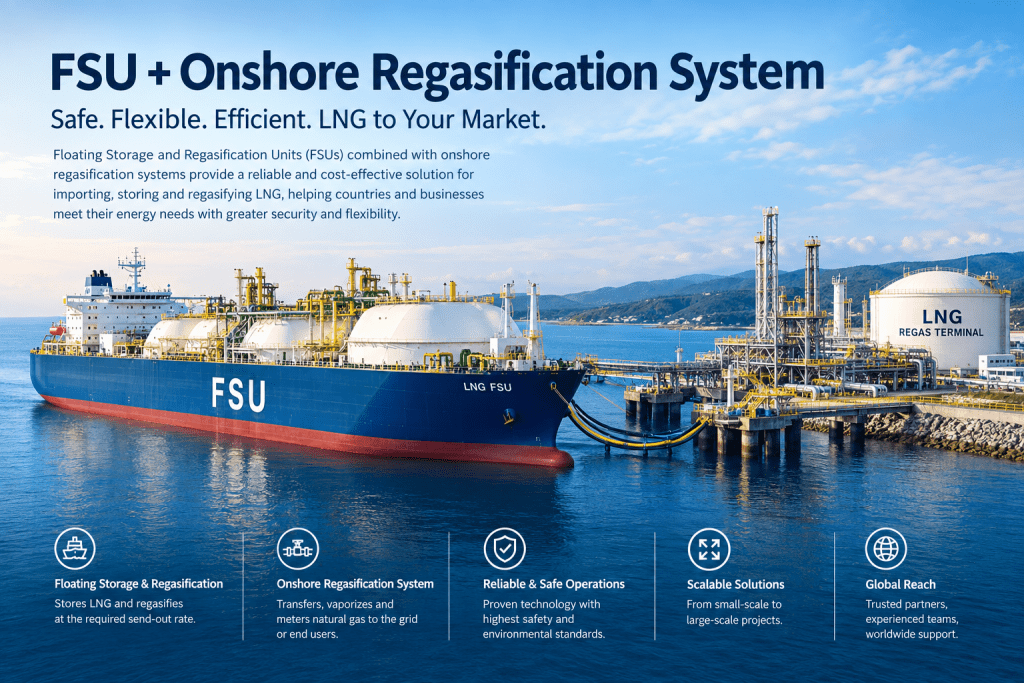
Floating LNG Storage with Modular Onshore Regasification
An FSU separates LNG storage from the regasification process. The FSU acts as the floating LNG storage and receiving facility, while regasification is carried out onshore.
How It Works
LNG carriers deliver LNG to the FSU through STS transfer. LNG is stored onboard the FSU and transferred to shore through a marine LNG transfer system. Onshore LNG pumps and a modular regasification system convert the LNG into natural gas before it is metered and delivered to the transmission grid or power plant.
Key Components
- LNG carrier-based FSU
- STS LNG receiving system
- Cryogenic marine LNG transfer system
- Onshore LNG receiving and high-pressure pumping
- Regasification system
- Gas metering, conditioning and export pipeline
Key Advantages
- Separates storage from regasification
- Modular and scalable onshore facility
- Potentially reduced offshore process complexity
- Can be developed with limited onshore land requirements
- May reduce the need for conventional large marine infrastructure, depending on the selected transfer system
- Provides flexibility for future capacity expansion
Best Suited For
Projects seeking a flexible alternative or complement to FSRU infrastructure, particularly where onshore regasification and modular expansion are attractive.
FSU + Offshore Regasification
Floating LNG Storage with Offshore Regasification
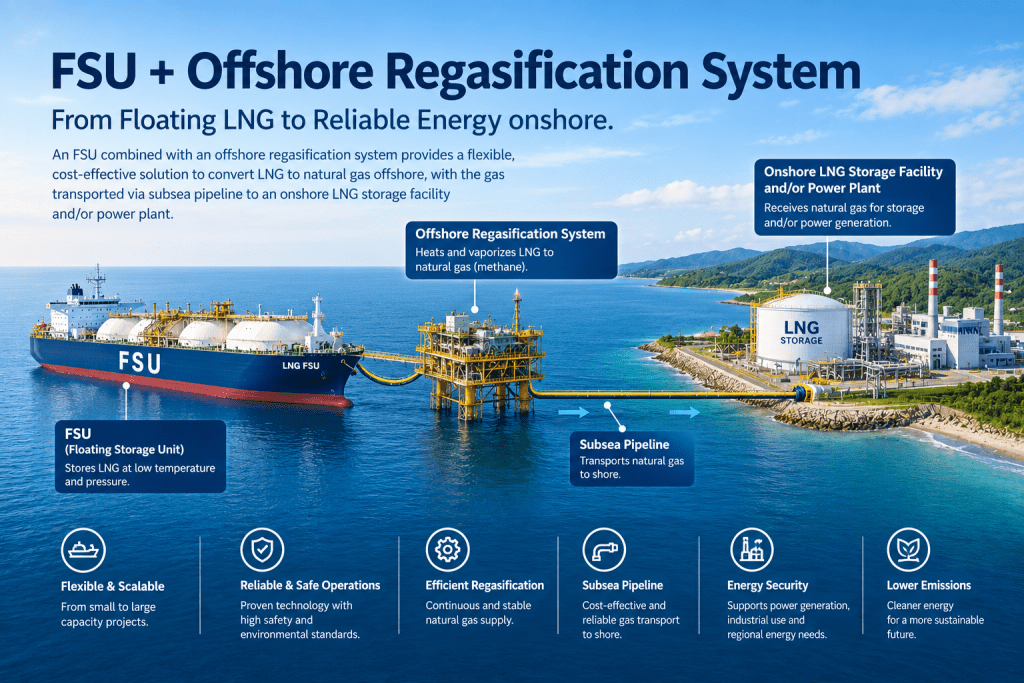
This configuration separates LNG storage and regasification into two offshore facilities.
How It Works
LNG carriers deliver LNG to the FSU through STS transfer. LNG is transferred from the FSU to a separate offshore regasification facility, where it is converted to natural gas. The gas is then transported to shore through a subsea high-pressure gas pipeline.
Key Components
- LNG carrier-based FSU
- STS LNG receiving system
- Offshore LNG transfer system
- Offshore regasification facility
- Gas metering and conditioning
- Subsea gas export pipeline
Key Advantages
- Floating storage and regasification can be optimized independently
- Limited onshore LNG infrastructure
- Suitable where offshore space and marine conditions are favorable
- Modular approach can support future capacity expansion
- Can reduce the need for major onshore LNG facilities
Best Suited For
Projects where offshore regasification is technically and economically attractive and suitable marine conditions are available.
Conventional Onshore LNG Terminal
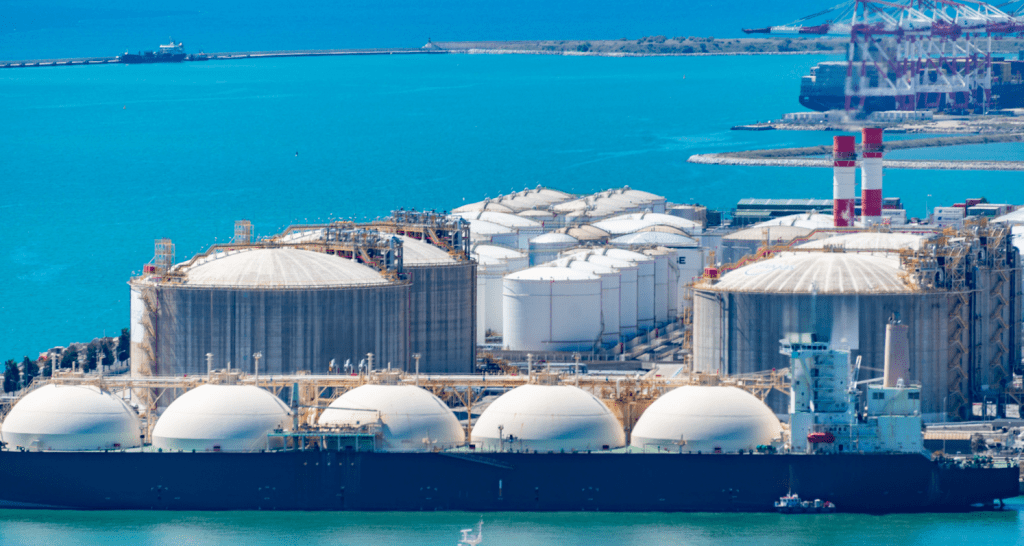
Onshore LNG Storage & Regasification Terminal
A conventional LNG terminal receives LNG from LNG carriers at a dedicated marine terminal, transfers the LNG to large onshore cryogenic storage tanks, and regasifies the LNG through an onshore regasification system before delivering natural gas to the transmission grid or power plant.
How It Works
LNG carriers berth at a dedicated LNG terminal and unload LNG through marine loading arms or equivalent transfer systems. LNG is stored in large onshore storage tanks and then pumped to the regasification system for delivery as natural gas.
Key Characteristics
- Large onshore LNG storage tanks
- Dedicated LNG carrier berth and marine unloading facilities
- Onshore LNG pumps and regasification system
- Gas metering, conditioning and export facilities
- Permanent infrastructure designed for long-term operation
Best Suited For
Large, long-term LNG import projects where suitable land, port infrastructure and marine access are available and a permanent onshore LNG terminal is commercially and technically justified.
Comparing the four main LNG import architectures:
| Solution | LNG Storage | Regasification |
|---|---|---|
| FSRU | Floating | Onboard FSRU |
| FSU + Onshore Regas | Floating | Onshore |
| FSU + Offshore Regas | Floating | Offshore |
| Conventional Onshore Terminal | Onshore | Onshore |
Selecting the Right Architecture
The optimal configuration depends on several factors, including:
- LNG demand and required capacity
- Available marine and onshore infrastructure
- Water depth and seabed conditions
- Distance from the LNG storage facility to shore
- Gas transmission infrastructure
- Land availability
- Metocean and environmental conditions
- Marine navigation and safety requirements
- Capital cost, operating cost and project schedule
- Future expansion requirements
No single architecture is suitable for every project. FSRU, FSU + Onshore Regasification and FSU + Offshore Regasification can each provide effective LNG import solutions depending on the specific project requirements.
Flexible & Modular LNG Infrastructure
FSU-based solutions can also be considered as part of a broader LNG import strategy, providing additional storage and regasification capacity alongside existing or planned FSRU infrastructure.
Our role is to help identify and connect suitable FSRU, FSU, LNG transfer, regasification and project development solutions through an international network of experienced partners.